LG OLED65G2
- руководство по ремонту (сервис-мануал)
Текст из PDF
НОВОЕ
Скриншоты PDF
Первые 12 страниц
Посмотреть весь текст PDF
Извлечено автоматически
СТРАНИЦА PDF
Страница 1
Все сервис мануалы для телевизоров LG: http://webos-forums.ru/topic3291.html
OLED TV
SERVICE MANUAL
CHASSIS : E*21G
MODEL : OLED65G2**A
CAUTION
BEFORE SER...
СТРАНИЦА PDF
Страница 2
CONTENTS
CONTENTS ............................................................................................... 2
SAFETY PRECAUTIONS ......................................................................... 3
SERVICING PRECAUTIONS ...............
СТРАНИЦА PDF
Страница 3
SAFETY PRECAUTIONS
IMPORTANT SAFETY NOTICE
Many electrical and mechanical parts in this chassis have special safety-related characteristics. These parts are identified by in the
Exploded View.
It is ...
СТРАНИЦА PDF
Страница 4
SERVICING PRECAUTIONS
CAUTION: Before servicing receivers covered by this service 2. After removing an electrical assembly equipped with ES
manual and its supplements and addenda, read and follow the devices, place ...
СТРАНИЦА PDF
Страница 5
IC Remove/Replacement 3. Solder the connections.
Some chassis circuit boards have slotted holes (oblong) through CAUTION: Maintain original spacing between the replaced
which the IC l...
СТРАНИЦА PDF
Страница 6
SPECIFICATION
NOTE : Specifications and others are subject to change without notice for improvement.
1. Application range 3. Test method
This specification is applied to the LED TV used E...
СТРАНИЦА PDF
Страница 7
No. Item Specification Remarks
# FOR EU/CIS/AFRICA/OCEANIA/ASIA
1 ) Digital TV
-DVB-T / DVB-T2*
...
СТРАНИЦА PDF
Страница 8
No. Item Specification Remarks
Antenna, HDMI1, HDMI2, HDMI3, HDMI4 USB1,
5 Head Phone out ...
СТРАНИЦА PDF
Страница 9
No. Item Specification Remarks
Digital : ATSC, 64 & 256 QAM
...
СТРАНИЦА PDF
Страница 10
5. External Input Support Format
5.1. HDMI input(DTV)
No. Resolution H-freq(kHz) V-freq.(kHz) Pixel clock(MHz) Proposed Remarks
1 640*480 31.46 59.94 25.125 SDTV 4...
СТРАНИЦА PDF
Страница 11
5.2. HDMI Input (PC)
No. Resolution H-freq(kHz) V-freq.(kHz) Pixel clock(MHz) Proposed Remarks
1 640*350 31.46 70.09 25.17 EGA
2 720*400 31....
СТРАНИЦА PDF
Страница 12
SOFTWARE UPDATE
1. USB DOWNLOAD 2. NSU DOWNLOAD
(1) Plug in the USB to the TV (This Function is needed to connect to the internet.)
(2) If there are update-a...
Другие инструкции и файлы
Все сервис мануалы для телевизоров LG: http://webos-forums.ru/topic3291.html
OLED TV
SERVICE MANUAL
CHASSIS : E*21G
MODEL : OLED65G2**A
CAUTION
BEFORE SERVICING THE CHASSIS, READ THE SAFETY PRECAUTIONS IN THIS MANUAL.
P/NO : MFL71888124 (2201-REV00)
Any reproduction, duplication, distribution (including by way of email, facsimile or other electronic means),
publication, modification, copying or transmission of this Service Manual is STRICTLY PROHIBITED unless you
have obtained the prior written consent of the LG Electronics entity from which you received this Service Manual.
The material covered by this prohibition includes, without limitation, any text, graphics or logos in this Service
Manual.
Copyright © 2022 LG Electronics Inc. All rights reserved. Only training and service purposes.
CONTENTS
CONTENTS ............................................................................................... 2
SAFETY PRECAUTIONS ......................................................................... 3
SERVICING PRECAUTIONS .................................................................... 4
SPECIFICATION ....................................................................................... 6
SOFTWARE UPDATE ............................................................................. 12
BLOCK DIAGRAM .................................................................................. 14
EXPLODED VIEW ................................................................................... 15
ASSEMBLY / DISASSEMBLY GUIDE..................................................... 16
TROUBLE SHOOTING GUIDE ................................................. APPENDIX
-2- Copyright © LG Electronics Inc. All rights reserved.
Only training and service purposes.
SAFETY PRECAUTIONS
IMPORTANT SAFETY NOTICE
Many electrical and mechanical parts in this chassis have special safety-related characteristics. These parts are identified by in the
Exploded View.
It is essential that these special safety parts should be replaced with the same components as recommended in this manual to prevent
Shock, Fire, or other Hazards.
Do not modify the original design without permission of manufacturer.
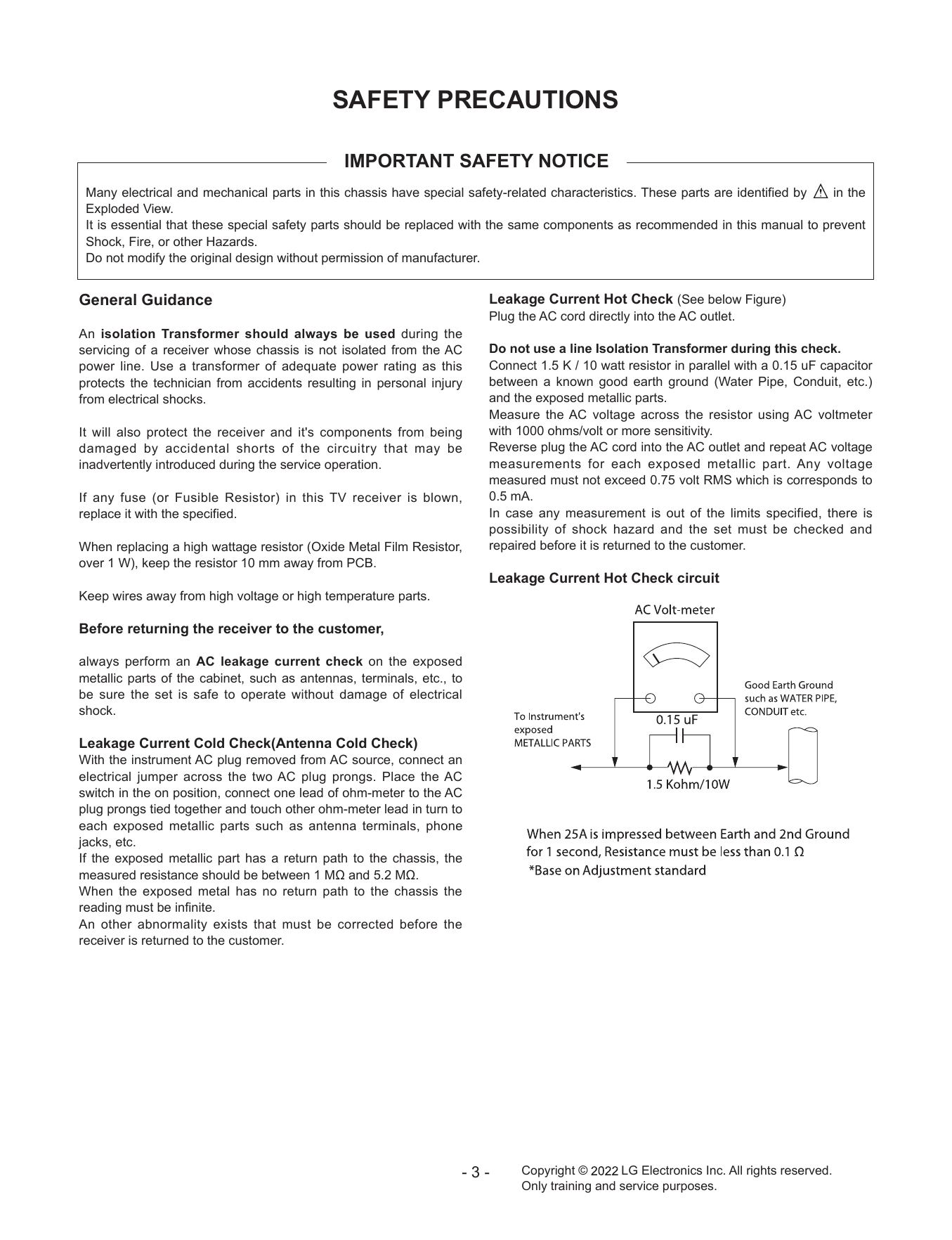
General Guidance Leakage Current Hot Check (See below Figure)
Plug the AC cord directly into the AC outlet.
An isolation Transformer should always be used during the
servicing of a receiver whose chassis is not isolated from the AC Do not use a line Isolation Transformer during this check.
power line. Use a transformer of adequate power rating as this Connect 1.5 K / 10 watt resistor in parallel with a 0.15 uF capacitor
protects the technician from accidents resulting in personal injury between a known good earth ground (Water Pipe, Conduit, etc.)
from electrical shocks. and the exposed metallic parts.
Measure the AC voltage across the resistor using AC voltmeter
It will also protect the receiver and it's components from being with 1000 ohms/volt or more sensitivity.
damaged by accidental shorts of the circuitry that may be Reverse plug the AC cord into the AC outlet and repeat AC voltage
inadvertently introduced during the service operation. measurements for each exposed metallic part. Any voltage
measured must not exceed 0.75 volt RMS which is corresponds to
If any fuse (or Fusible Resistor) in this TV receiver is blown, 0.5 mA.
replace it with the specified. In case any measurement is out of the limits specified, there is
possibility of shock hazard and the set must be checked and
When replacing a high wattage resistor (Oxide Metal Film Resistor, repaired before it is returned to the customer.
over 1 W), keep the resistor 10 mm away from PCB.
Leakage Current Hot Check circuit
Keep wires away from high voltage or high temperature parts.
Before returning the receiver to the customer,
always perform an AC leakage current check on the exposed
metallic parts of the cabinet, such as antennas, terminals, etc., to
be sure the set is safe to operate without damage of electrical
shock.
Leakage Current Cold Check(Antenna Cold Check)
With the instrument AC plug removed from AC source, connect an
electrical jumper across the two AC plug prongs. Place the AC
switch in the on position, connect one lead of ohm-meter to the AC
plug prongs tied together and touch other ohm-meter lead in turn to
each exposed metallic parts such as antenna terminals, phone
jacks, etc.
If the exposed metallic part has a return path to the chassis, the
measured resistance should be between 1 MΩ and 5.2 MΩ.
When the exposed metal has no return path to the chassis the
reading must be infinite.
An other abnormality exists that must be corrected before the
receiver is returned to the customer.
-3- Copyright © LG Electronics Inc. All rights reserved.
Only training and service purposes.
SERVICING PRECAUTIONS
CAUTION: Before servicing receivers covered by this service 2. After removing an electrical assembly equipped with ES
manual and its supplements and addenda, read and follow the devices, place the assembly on a conductive surface such as
SAFETY PRECAUTIONS on page 3 of this publication. aluminum foil, to prevent electrostatic charge buildup or expo-
NOTE: If unforeseen circumstances create conflict between the sure of the assembly.
following servicing precautions and any of the safety precautions 3. Use only a grounded-tip soldering iron to solder or unsolder
on page 3 of this publication, always follow the safety precau- ES devices.
tions. Remember: Safety First. 4. Use only an anti-static type solder removal device. Some sol-
der removal devices not classified as “anti-static” can generate
General Servicing Precautions electrical charges sufficient to damage ES devices.
1. Always unplug the receiver AC power cord from the AC power 5. Do not use freon-propelled chemicals. These can generate
source before; electrical charges sufficient to damage ES devices.
a. Removing or reinstalling any component, circuit board 6. Do not remove a replacement ES device from its protective
module or any other receiver assembly. package until immediately before you are ready to install it.
b. Disconnecting or reconnecting any receiver electrical plug (Most replacement ES devices are packaged with leads elec-
or other electrical connection. trically shorted together by conductive foam, aluminum foil or
c. Connecting a test substitute in parallel with an electrolytic comparable conductive material).
capacitor in the receiver. 7. Immediately before removing the protective material from the
CAUTION: A wrong part substitution or incorrect polarity leads of a replacement ES device, touch the protective mate-
installation of electrolytic capacitors may result in an explo- rial to the chassis or circuit assembly into which the device will
sion hazard. be installed.
2. Test high voltage only by measuring it with an appropriate CAUTION: Be sure no power is applied to the chassis or cir-
high voltage meter or other voltage measuring device (DVM, cuit, and observe all other safety precautions.
FETVOM, etc) equipped with a suitable high voltage probe. 8. Minimize bodily motions when handling unpackaged replace-
Do not test high voltage by "drawing an arc". ment ES devices. (Otherwise harmless motion such as the
3. Do not spray chemicals on or near this receiver or any of its brushing together of your clothes fabric or the lifting of your
assemblies. foot from a carpeted floor can generate static electricity suf-
4. Unless specified otherwise in this service manual, clean ficient to damage an ES device.)
electrical contacts only by applying the following mixture to the
contacts with a pipe cleaner, cotton-tipped stick or comparable General Soldering Guidelines
non-abrasive applicator; 10 % (by volume) Acetone and 90 % 1. Use a grounded-tip, low-wattage soldering iron and appropri-
(by volume) isopropyl alcohol (90 % - 99 % strength) ate tip size and shape that will maintain tip temperature within
CAUTION: This is a flammable mixture. the range or 500 °F to 600 °F.
Unless specified otherwise in this service manual, lubrication 2. Use an appropriate gauge of RMA resin-core solder composed
of contacts in not required. of 60 parts tin/40 parts lead.
5. Do not defeat any plug/socket B+ voltage interlocks with which 3. Keep the soldering iron tip clean and well tinned.
receivers covered by this service manual might be equipped. 4. Thoroughly clean the surfaces to be soldered. Use a mall wire-
6. Do not apply AC power to this instrument and/or any of its bristle (0.5 inch, or 1.25 cm) brush with a metal handle.
electrical assemblies unless all solid-state device heat sinks Do not use freon-propelled spray-on cleaners.
are correctly installed. 5. Use the following unsoldering technique
7. Always connect the test receiver ground lead to the receiver a. Allow the soldering iron tip to reach normal temperature.
chassis ground before connecting the test receiver positive (500 °F to 600 °F)
lead. b. Heat the component lead until the solder melts.
Always remove the test receiver ground lead last. c. Quickly draw the melted solder with an anti-static, suction-
8. Use with this receiver only the test fixtures specified in this type solder removal device or with solder braid.
service manual. CAUTION: Work quickly to avoid overheating the circuit
CAUTION: Do not connect the test fixture ground strap to any board printed foil.
heat sink in this receiver. 6. Use the following soldering technique.
a. Allow the soldering iron tip to reach a normal temperature
Electrostatically Sensitive (ES) Devices (500 °F to 600 °F)
Some semiconductor (solid-state) devices can be damaged eas- b. First, hold the soldering iron tip and solder the strand
ily by static electricity. Such components commonly are called against the component lead until the solder melts.
Electrostatically Sensitive (ES) Devices. Examples of typical ES c. Quickly move the soldering iron tip to the junction of the
devices are integrated circuits and some field-effect transistors component lead and the printed circuit foil, and hold it there
and semiconductor “chip” components. The following techniques only until the solder flows onto and around both the compo-
should be used to help reduce the incidence of component dam- nent lead and the foil.
age caused by static by static electricity. CAUTION: Work quickly to avoid overheating the circuit
1. Immediately before handling any semiconductor component or board printed foil.
semiconductor-equipped assembly, drain off any electrostatic d. Closely inspect the solder area and remove any excess or
charge on your body by touching a known earth ground. Alter- splashed solder with a small wire-bristle brush.
natively, obtain and wear a commercially available discharg-
ing wrist strap device, which should be removed to prevent
potential shock reasons prior to applying power to the unit
under test.
-4- Copyright © LG Electronics Inc. All rights reserved.
Only training and service purposes.
IC Remove/Replacement 3. Solder the connections.
Some chassis circuit boards have slotted holes (oblong) through CAUTION: Maintain original spacing between the replaced
which the IC leads are inserted and then bent flat against the cir- component and adjacent components and the circuit board to
cuit foil. When holes are the slotted type, the following technique prevent excessive component temperatures.
should be used to remove and replace the IC. When working with
boards using the familiar round hole, use the standard technique Circuit Board Foil Repair
as outlined in paragraphs 5 and 6 above. Excessive heat applied to the copper foil of any printed circuit
board will weaken the adhesive that bonds the foil to the circuit
Removal board causing the foil to separate from or "lift-off" the board. The
1. Desolder and straighten each IC lead in one operation by following guidelines and procedures should be followed when-
gently prying up on the lead with the soldering iron tip as the ever this condition is encountered.
solder melts.
2. Draw away the melted solder with an anti-static suction-type At IC Connections
solder removal device (or with solder braid) before removing To repair a defective copper pattern at IC connections use the
the IC. following procedure to install a jumper wire on the copper pattern
Replacement side of the circuit board. (Use this technique only on IC connec-
1. Carefully insert the replacement IC in the circuit board. tions).
2. Carefully bend each IC lead against the circuit foil pad and
solder it. 1. Carefully remove the damaged copper pattern with a sharp
3. Clean the soldered areas with a small wire-bristle brush. knife. (Remove only as much copper as absolutely necessary).
(It is not necessary to reapply acrylic coating to the areas). 2. carefully scratch away the solder resist and acrylic coating (if
used) from the end of the remaining copper pattern.
"Small-Signal" Discrete Transistor 3. Bend a small "U" in one end of a small gauge jumper wire and
Removal/Replacement carefully crimp it around the IC pin. Solder the IC connection.
1. Remove the defective transistor by clipping its leads as close 4. Route the jumper wire along the path of the out-away copper
as possible to the component body. pattern and let it overlap the previously scraped end of the
2. Bend into a "U" shape the end of each of three leads remain- good copper pattern. Solder the overlapped area and clip off
ing on the circuit board. any excess jumper wire.
3. Bend into a "U" shape the replacement transistor leads.
4. Connect the replacement transistor leads to the corresponding At Other Connections
leads extending from the circuit board and crimp the "U" with Use the following technique to repair the defective copper pattern
long nose pliers to insure metal to metal contact then solder at connections other than IC Pins. This technique involves the
each connection. installation of a jumper wire on the component side of the circuit
board.
Power Output, Transistor Device
Removal/Replacement 1. Remove the defective copper pattern with a sharp knife.
1. Heat and remove all solder from around the transistor leads. Remove at least 1/4 inch of copper, to ensure that a hazardous
2. Remove the h t sink mounting screw (if so equipped). condition will not exist if the jumper wire opens.
3. Carefully remove the transistor from the heat sink of the circuit 2. Trace along the copper pattern from both sides of the pattern
board. break and locate the nearest component that is directly con-
4. Insert new transistor in the circuit board. nected to the affected copper pattern.
5. Solder each transistor lead, and clip off excess lead. 3. Connect insulated 20-gauge jumper wire from the lead of the
6. Replace heat sink. nearest component on one side of the pattern break to the
lead of the nearest component on the other side.
Diode Removal/Replacement Carefully crimp and solder the connections.
1. Remove defective diode by clipping its leads as close as pos- CAUTION: Be sure the insulated jumper wire is dressed so the
sible to diode body. it does not touch components or sharp edges.
2. Bend the two remaining leads perpendicular y to the circuit
board.
3. Observing diode polarity, wrap each lead of the new diode
around the corresponding lead on the circuit board.
4. Securely crimp each connection and solder it.
5. Inspect (on the circuit board copper side) the solder joints of
the two "original" leads. If they are not shiny, reheat them and
if necessary, apply additional solder.
Fuse and Conventional Resistor
Removal/Replacement
1. Clip each fuse or resistor lead at top of the circuit board hollow
stake.
2. Securely crimp the leads of replacement component around
notch at stake top.
-5- Copyright © LG Electronics Inc. All rights reserved.
Only training and service purposes.
SPECIFICATION
NOTE : Specifications and others are subject to change without notice for improvement.
1. Application range 3. Test method
This specification is applied to the LED TV used E*21G (1) Performance: LGE TV test method followed
chassis. (2) Demanded other specification
- Safety : CE, IEC specification
- EMC : CE, IEC specification
2. Requirement for Test
Each part is tested as below without special notice.
(1) Temperature: 25 °C ± 5 °C(77 °F ± 9 °F), CST: 40 °C ± 2 °C
(2) Relative Humidity: 60 % ± 10 %
(3) Power Voltage
: Standard input voltage (AC 100-240 V~, 50/60 Hz)
* Standard Voltage of each products is marked by models.
(4) Specification and performance of each parts are followed
each drawing and specification by part number in
accordance with BOM.
(5) The receiver must be operated for about 20 minutes prior
to the adjustment.
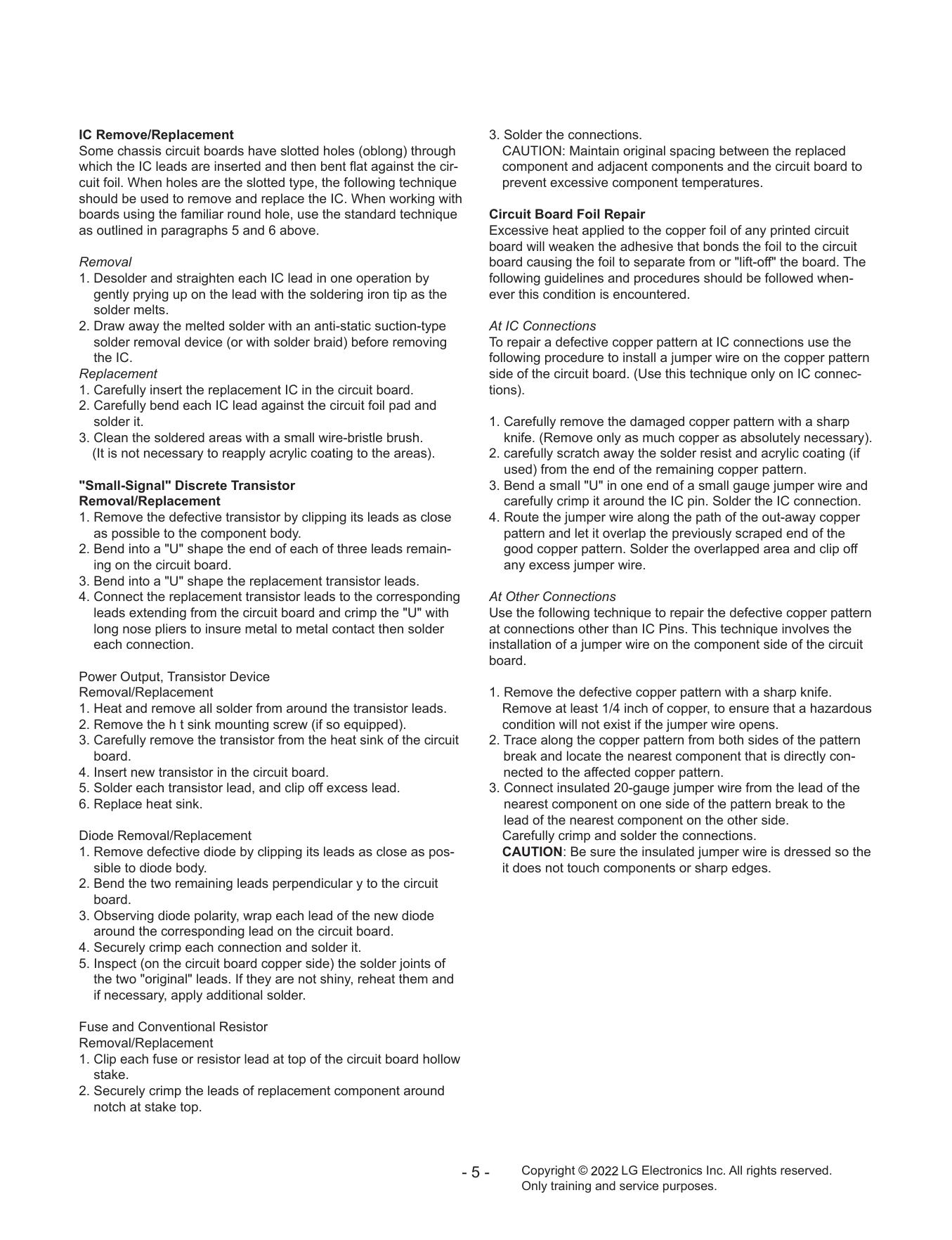
4. Model General Specification
(1) EU / CIS / AFRICA / OCEANIA / ASIA / CHINA / HONGKONG / PHILIPPINES
No. Item Specification Remarks
1) EU/CIS/AFRICA
2) OCEANIA/ASIA
1 Market
3) CHINA/HONGKONG
4) PHILIPPINES
1) EU/CIS/AFRICA
- Digital TV : DVB-T/T2, DVB-C, DVB-S/S2,
- Analogue TV : P AL B/B, PAL B/G, PAL D/K,
PAL-I, SECAM B/G, SECAM
D/K, NTSC-M
2) OCEANIA/ASIA
- Digital TV : D
VB-T/T2, DVB-C, DVB-S/
S2(New zealand only)
- Analogue TV : P AL B/B, PAL B/G, PAL D/K,
PAL-I, SECAM B/G, SECAM
2 Broadcasting system Depending on country
D/K, NTSC-M
3) China/Hongkong
- Digital TV : D
TMB (China/Hongkong), DVB-C
(China)
- Analogue TV : P AL D/K,I, NTSC-M (China/
Hongkong)
4) Philliphine
- Digital TV : ISDB-T
- Analogue TV : NTSC-M
-6- Copyright © LG Electronics Inc. All rights reserved.
Only training and service purposes.
No. Item Specification Remarks
# FOR EU/CIS/AFRICA/OCEANIA/ASIA
1 ) Digital TV
-DVB-T / DVB-T2*
-VHF III : 174 ~ 230 MHz
-UHF IV : 470 ~ 606 MHz
-UHF V : 606 ~ 862 MHz
-S Band II : 230 ~ 300 MHz
-S Band III : 300 ~ 470 MHz
-DVB-S/S2* (950 ~ 2150 MHz)
-DVB-C* (46 ~ 890 MHz)
2) Analogue TV (46 ~ 862 MHz)
# FOR CHINA
1) Only DVB-T2/C/S2 support model only.
1) PAL-DK:VHF/UHF 1~62, Cable:1~41
3 Program coverage
2) PAL-I: VHF/UHF 1~69, Cable:1~47
2)3)4) China/Hongkong/Philippine separate marking
3) NTSC M: VHF/UHF 2~78, Cable:1~71
4) DTMB:1~62
5) DVB-C:52.5MHz~866MHz
# FOR HONGKONG
1) PAL-DK:VHF/UHF 1~69, Cable:1~47
2) PAL-I: VHF/UHF 1~69, Cable:1~47
3) NTSC M: VHF/UHF 2~78, Cable:1~71
4) DTMB:21~69
# FOR Philippine
1) ISDB-T: UHF : 2~69
2) NTSC M: VHF/UHF : 2~69, CATV: 1~135
# EU/CIS/AFRICA/OCEANIA/ASIA
► DVB-T
- Guard Interval(Bitrate_Mbit/s): 1/4, 1/8, 1/16, 1/32
- Modulation: Code Rate
QPSK : 1/2, 2/3, 3/4, 5/6, 7/8
16-QAM : 1/2, 2/3, 3/4, 5/6, 7/8
64-QAM : 1/2, 2/3, 3/4, 5/6, 7/8
► DVB-T2
- Guard Interval(Bitrate_Mbit/s)
1/4, 1/8, 1/16, 1/32, 1/128, 19/128, 19/256,
- Modulation : Code Rate
QPSK : 1/2, 2/5, 2/3, 3/4, 5/6
16-QAM : 1/2, 2/5, 2/3, 3/4, 5/6
64-QAM : 1/2, 2/5, 2/3, 3/4, 5/6
256-QAM : 1/2, 2/5, 2/3, 3/4, 5/6
► DVB-C
- Symbolrate: 4.0Msymbols/s to 7.2Msymbols/s
# EU/CIS/AFRICA/OCEANIA/ASIA
- Modulation: 16QAM, 64-QAM, 128-QAM and 256-QAM
Analog : Upper Heterodyne
► DVB-S/S2(Except Asia)
Digital : COFDM(DVB-T) Only DVB-T Model
- Symbolrate
Digital : COFDM(DVB-T/T2) Only DVB-T2 Model
DVB-S2 (8PSK / QPSK) : 2 ~ 45Msymbol/s
Digital : QAM
4 Receiving system DVB-S (QPSK) : 2 ~ 45Msymbol/s
- Viterbi
DVB-S mode : 1/2, 2/3, 3/4, 5/6, 7/8
# China/Hongkong
DVB-S2 mode: 1/2, 2/3, 3/4, 3/5, 4/5, 5/6, 8/9, 9/10
Analog : Upper Heterodyne
Digital : COFDM, QAM
#China/Hongkong
► DTMB ( Carrier, Code Rate, Constellation, Frame Header, Interleaving)
* China
- MODE1 : 3780, 0.4, 16QAM, PN945/VARIABLE, 720
- MODE2 : 1, 0.8, 4QAM, PN595, 720
- MODE3 : 3780, 0.6, 16QAM, PN945/VARIABLE, 720
- MODE4 : 1, 0.8, 16QAM, PN595, 720
- MODE5 : 3780, 0.8, 16QAM, PN420/VARIABLE, 720
- MODE6 : 3780, 0.6, 64QAM, PN420/VARIABLE, 720
- MODE7 : 1, 0.8, 32QAM, PN595, 720
- MODE8 : 3780, 0.8, 16QAM, PN945/VARIABLE, 720
- MODE9 : 3780, 0.6, 64QAM, PN945/VARIABLE, 720
- MODE10 : 3780, 0.8, 64QAM, PN420/VARIABLE, 720
* Hong Kong - 3780, 0.4/0.6, 4/16/64QAM, PN945, 720
► DVB-C
- Symbolrate : 4.0Msymbols/s to 7.2Msymbols/s
- Modulation : 16QAM, 64-QAM, 128-QAM and 256-QAM
-7- Copyright © LG Electronics Inc. All rights reserved.
Only training and service purposes.
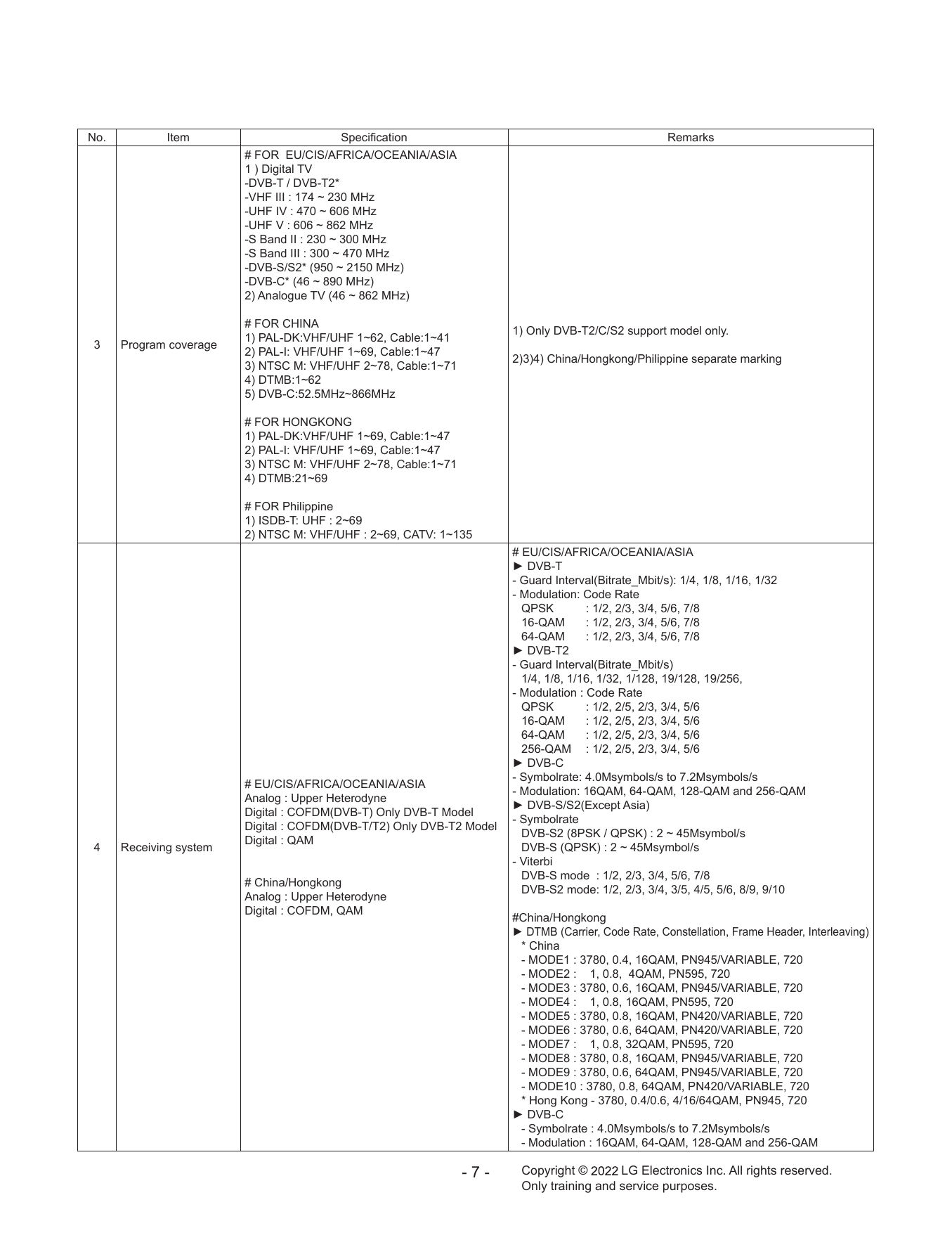
No. Item Specification Remarks
Antenna, HDMI1, HDMI2, HDMI3, HDMI4 USB1,
5 Head Phone out Depending on country
USB2, USB3, AV
HDMI1
HDMI HDMI2
6 PC / DTV Format Support HDMI2.1
Input HDMI3
HDMI4
7 Video Input RCA PAL, SECAM, NTSC 4 System : PAL, SECAM, NTSC, PAL60
8 Audio Input DVI Audio, Component, AV
9 SPDIF out (1 EA) Optical Audio out
10 USB Input (3 EA) EMF, For SVC (download)
Ethernet Connect
11 STP cable
(1EA)
PCMCIA Card slot
12 PCMCIA Slot only EU/CIS
(1EA)
(2) North America / Central and South America / Colombia / Taiwan / Japan / Mexico
No. Item Specification Remarks
Korea / North America / Central and South
1 Market
America / Colombia / Taiwan / Japan / Mexico
ATSC / NTSC-M, 64 & 256 QAM North America
Digital : SBTVD (ISDBT)
Cenrtal and South America
Analog : NTSC / PAL-M / PAL-N
Digital : DVB-T / T2
Colombia / Panama
Analog : NTSC / PAL-M / PAL-N
2 Broadcasting system
Digital : ATSC, 64 & 256 QAM
Mexico
Analog : NTSC-M
Digital : DVB-T
Taiwan
Analog : NTSC-M
ISDB-T / ISDB-S/S3(BS/CS) Japan
VHF 2 ~ 13
UHF 14 ~ 69
DTV 2 ~ 69 North America / Mexico
CATV 1 ~ 135
CADTV 1 ~ 135
VHF 2 ~ 13
UHF 14 ~ 69
Cenrtal and South America
DTV 2 ~ 69
CATV 1 ~ 135
VHF 2 ~ 13
3 Available Channel
UHF 14 ~ 69
Colombia / Panama / Taiwan
DTV 2 ~ 69
CATV 1 ~ 125
VHF 1~12
UHF 13~62
Japan
CATV C13~C63
BS Digital 000~999
CS Digital 000~999 *BS8K is only for 8K Models.
(4K Models do not support BS8K Digital Channels.)
BS4K/8K Digital 001~499
CS4K Digital 500~999
-8- Copyright © LG Electronics Inc. All rights reserved.
Only training and service purposes.
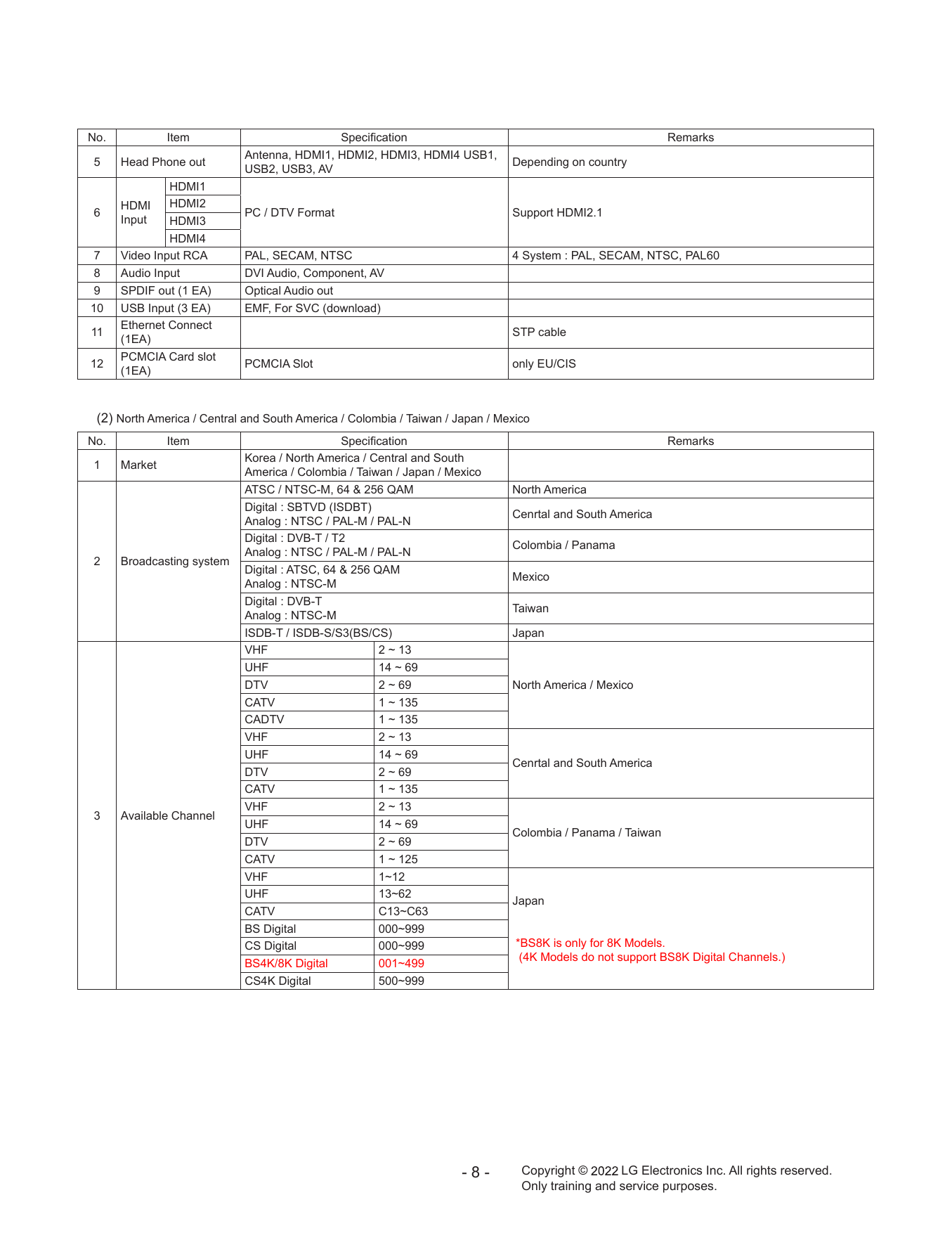
No. Item Specification Remarks
Digital : ATSC, 64 & 256 QAM
for North America / Mexico model
Analog : NTSC-M
Digital : SBTVD (ISDBT)
for Central and South America model
Analog : NTSC / PAL-M / PAL-N
for Panama and Taiwan
► DVB-T
- Guard Interval(Bitrate_Mbit/s)
Digital : DVB-T 1/4, 1/8, 1/16, 1/32
Analog : NTSC / PAL-M / PAL-N - Modulation : Code Rate
QPSK/16-QAM/64-QAM
- Code Rate
4 Receiving system
1/2, 2/3, 3/4, 5/6, 7/8
for Colombia
► DVB-T2
- Guard Interval(Bitrate_Mbit/s)
Digital : DVB-T2 1/4, 19/256, 1/8, 1/16, 1/32, 1/128
Analog : NTSC / PAL-M / PAL-N - Modulation
QPSK, 16-QAM, 64-QAM, 256QAM
- Code Rate
1/2, 3/5, 2/3, 3/4, 4/5, 5/6
Terrestrial : BST-OFDM
For Japan model
Satellite BS/CS : 16APSK, 8PSK, QPSK, BPSK
HDMI 1
HDMI 2
5 HDMI Input PC / DTV Format Support HDMI2.1
HDMI 3
HDMI 4
SPDIF(1EA) Optical Audio out
6 Audio out
HeadPhone(1EA) HeadPhone out *Only 42/48C2 model & Japan all model
7 USB Input (3EA) EMF, DivX HD, For SVC (download) JPEG, MP3, DivX HD
8 Ethernet Connect (1EA) Ethernet Connect
-9- Copyright © LG Electronics Inc. All rights reserved.
Only training and service purposes.
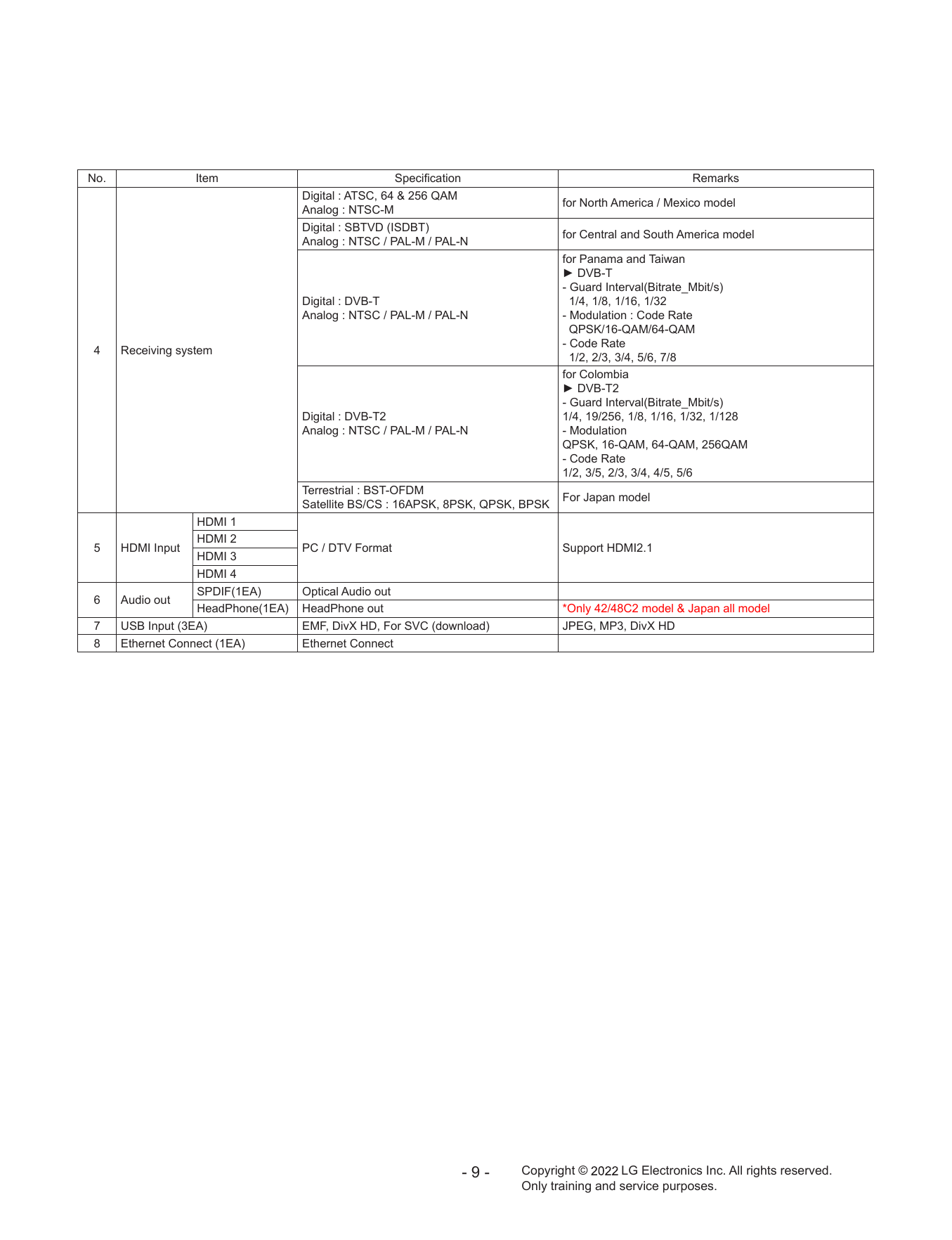
5. External Input Support Format
5.1. HDMI input(DTV)
No. Resolution H-freq(kHz) V-freq.(kHz) Pixel clock(MHz) Proposed Remarks
1 640*480 31.46 59.94 25.125 SDTV 480P
2 640*480 31.50 60.00 25.125 SDTV 480P
3 720*480 15.73 59.94 13.500 SDTV, DVD 480I(525I)
4 720*480 15.75 60.00 13.514 SDTV, DVD 480I(525I) Spec. out but display
5 720*576 15.62 50.00 13.500 SDTV, DVD 576I(625I) 50Hz
6 720*480 31.47 59.94 27 SDTV 480P
7 720*480 31.50 60.00 27.027 SDTV 480P
8 720*576 31.25 50.00 27 SDTV 576P
9 1280*720 37.5 50.00 74.25 HDTV 720P
10 1280*720 44.96 59.94 74.176 HDTV 720P
11 1280*720 45.00 60.00 74.25 HDTV 720P
12 1920*1080 33.72 59.94 74.176 HDTV 1080I
13 1920*1080 33.75 60.00 74.25 HDTV 1080I
14 1920*1080 28.12 50.00 74.25 HDTV 1080I
15 1920*1080 26.97 23.97 63.296 HDTV 1080P
16 1920*1080 27.00 24.00 63.36 HDTV 1080P
17 1920*1080 33.71 29.97 79.120 HDTV 1080P
18 1920*1080 33.75 30.00 79.20 HDTV 1080P
19 1920*1080 56.25 50.00 148.5 HDTV 1080P
20 1920*1080 67.43 59.94 148.350 HDTV 1080P
21 1920*1080 67.50 60.00 148.50 HDTV 1080P
22 1920*1080 135.00 120.00 HDTV 1080P
23 1920*1080 134.86 119.88 HDTV 1080P
24 1920*1080 112.50 100.00 HDTV 1080P
25 3840*2160 53.95 23.98 296.703 UDTV 2160P
26 3840*2160 54.00 24.00 297.00 UDTV 2160P
27 3840*2160 56.25 25.00 297.00 UDTV 2160P
28 3840*2160 61.43 29.97 296.703 UDTV 2160P
29 3840*2160 67.50 30.00 297.00 UDTV 2160P
When HDMI
30 3840*2160 112.5 50.00 594 UDTV 2160P
UHD DEEP COLOUR ON
When HDMI
31 3840*2160 134.86 59.94 593.407 UDTV 2160P
UHD DEEP COLOUR ON
When HDMI
32 3840*2160 135.00 60.00 594 UDTV 2160P
UHD DEEP COLOUR ON
33 4096*2160 53.95 23.98 296.703 UDTV 2160P
34 4096*2160 54.00 24.00 297 UDTV 2160P
35 4096*2160 56.25 25.00 297 UDTV 2160P
36 4096*2160 61.43 29.97 296.703 UDTV 2160P
37 4096*2160 67.50 30.00 297 UDTV 2160P
When HDMI
38 4096*2160 112.50 50.00 594 UDTV 2160P
UHD DEEP COLOUR ON
When HDMI
39 4096*2160 134.86 59.94 593.407 UDTV 2160P
UHD DEEP COLOUR ON
When HDMI
40 4096*2160 135.00 60.00 594 UDTV 2160P
UHD DEEP COLOUR ON
- 10 - Copyright © LG Electronics Inc. All rights reserved.
Only training and service purposes.
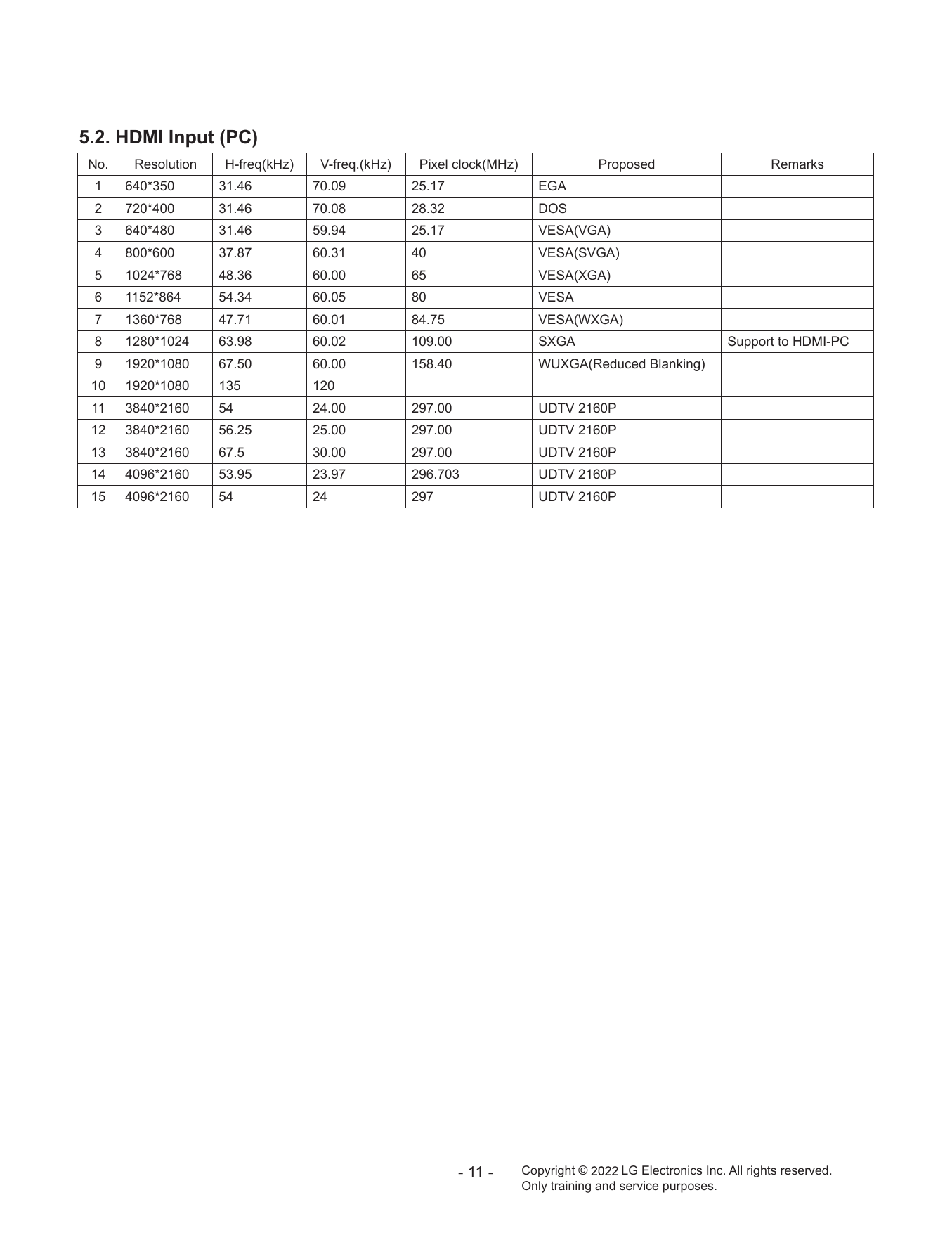
5.2. HDMI Input (PC)
No. Resolution H-freq(kHz) V-freq.(kHz) Pixel clock(MHz) Proposed Remarks
1 640*350 31.46 70.09 25.17 EGA
2 720*400 31.46 70.08 28.32 DOS
3 640*480 31.46 59.94 25.17 VESA(VGA)
4 800*600 37.87 60.31 40 VESA(SVGA)
5 1024*768 48.36 60.00 65 VESA(XGA)
6 1152*864 54.34 60.05 80 VESA
7 1360*768 47.71 60.01 84.75 VESA(WXGA)
8 1280*1024 63.98 60.02 109.00 SXGA Support to HDMI-PC
9 1920*1080 67.50 60.00 158.40 WUXGA(Reduced Blanking)
10 1920*1080 135 120
11 3840*2160 54 24.00 297.00 UDTV 2160P
12 3840*2160 56.25 25.00 297.00 UDTV 2160P
13 3840*2160 67.5 30.00 297.00 UDTV 2160P
14 4096*2160 53.95 23.97 296.703 UDTV 2160P
15 4096*2160 54 24 297 UDTV 2160P
- 11 - Copyright © LG Electronics Inc. All rights reserved.
Only training and service purposes.
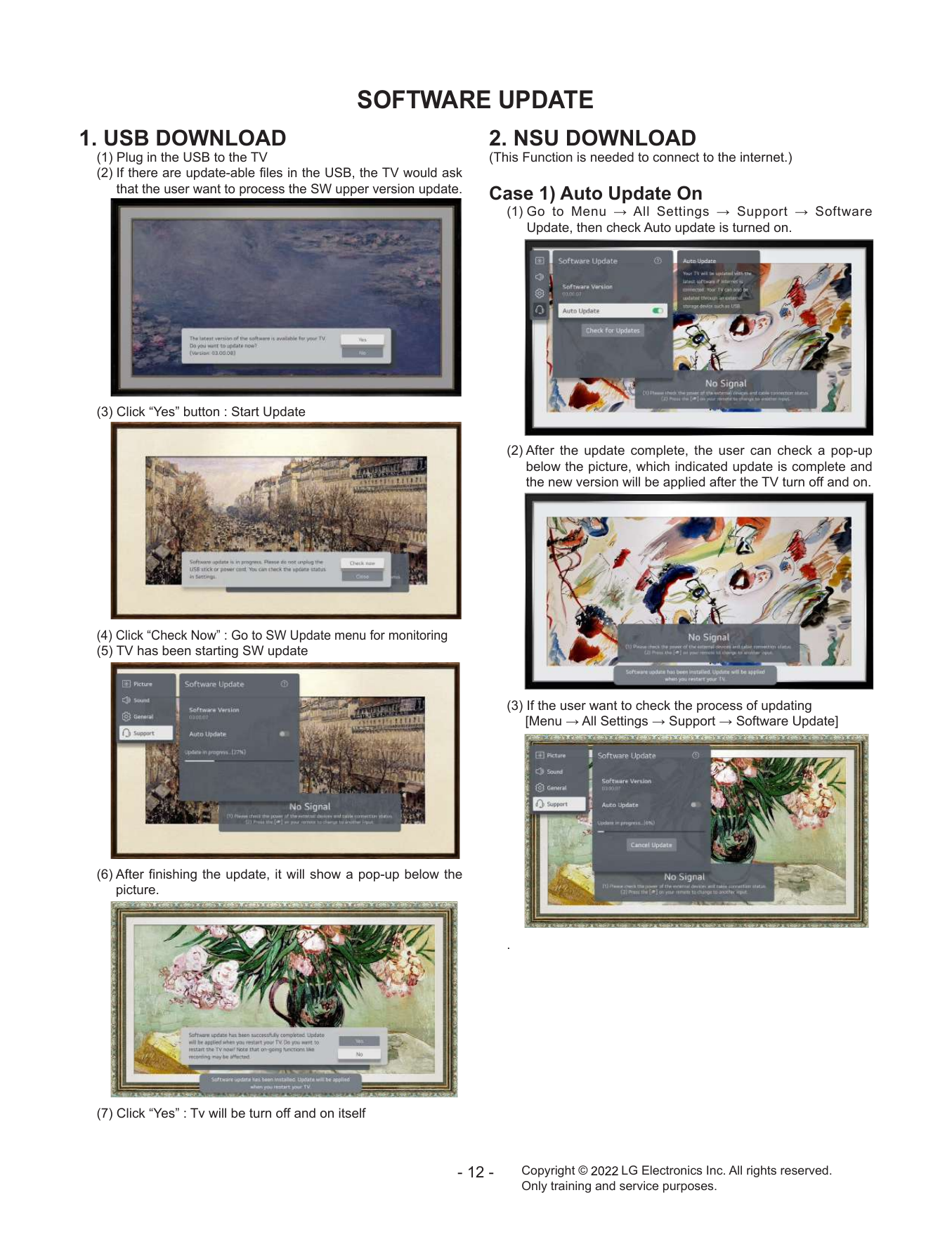
SOFTWARE UPDATE
1. USB DOWNLOAD 2. NSU DOWNLOAD
(1) Plug in the USB to the TV (This Function is needed to connect to the internet.)
(2) If there are update-able files in the USB, the TV would ask
that the user want to process the SW upper version update. Case 1) Auto Update On
(1) G o to Menu → All Settings → Support → Software
Update, then check Auto update is turned on.
(3) Click “Yes” button : Start Update
(2) After the update complete, the user can check a pop-up
below the picture, which indicated update is complete and
the new version will be applied after the TV turn off and on.
(4) Click “Check Now” : Go to SW Update menu for monitoring
(5) TV has been starting SW update
(3) If the user want to check the process of updating
[Menu → All Settings → Support → Software Update]
(6) After finishing the update, it will show a pop-up below the
picture.
.
(7) Click “Yes” : Tv will be turn off and on itself
- 12 - Copyright © LG Electronics Inc. All rights reserved.
Only training and service purposes.
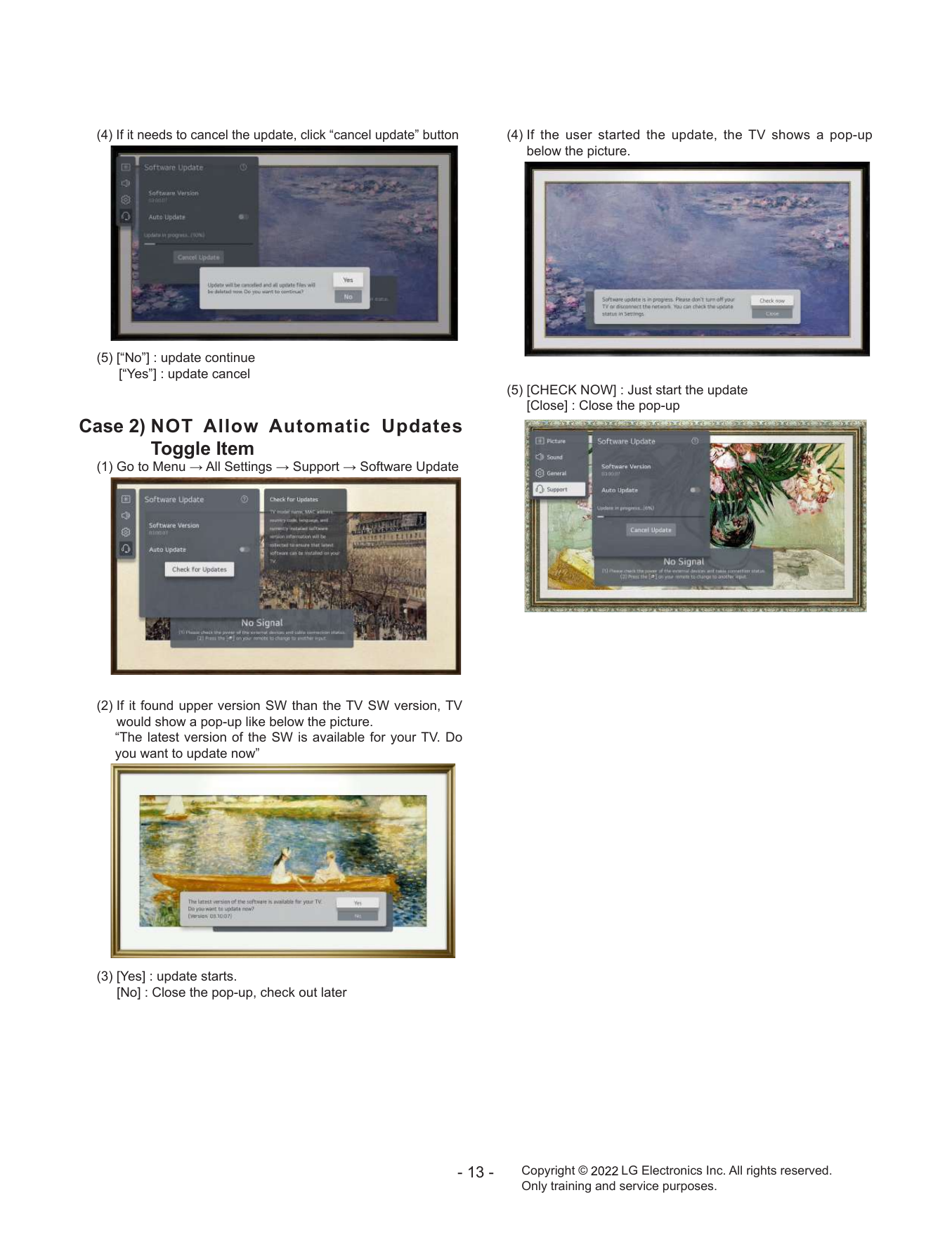
(4) If it needs to cancel the update, click “cancel update” button (4) If the user started the update, the TV shows a pop-up
below the picture.
(5) [“No”] : update continue
[“Yes”] : update cancel
(5) [CHECK NOW] : Just start the update
[Close] : Close the pop-up
Case 2) N
OT Allow Automatic Updates
Toggle Item
(1) Go to Menu → All Settings → Support → Software Update
(2) If it found upper version SW than the TV SW version, TV
would show a pop-up like below the picture.
“The latest version of the SW is available for your TV. Do
you want to update now”
(3) [Yes] : update starts.
[No] : Close the pop-up, check out later
- 13 - Copyright © LG Electronics Inc. All rights reserved.
Only training and service purposes.
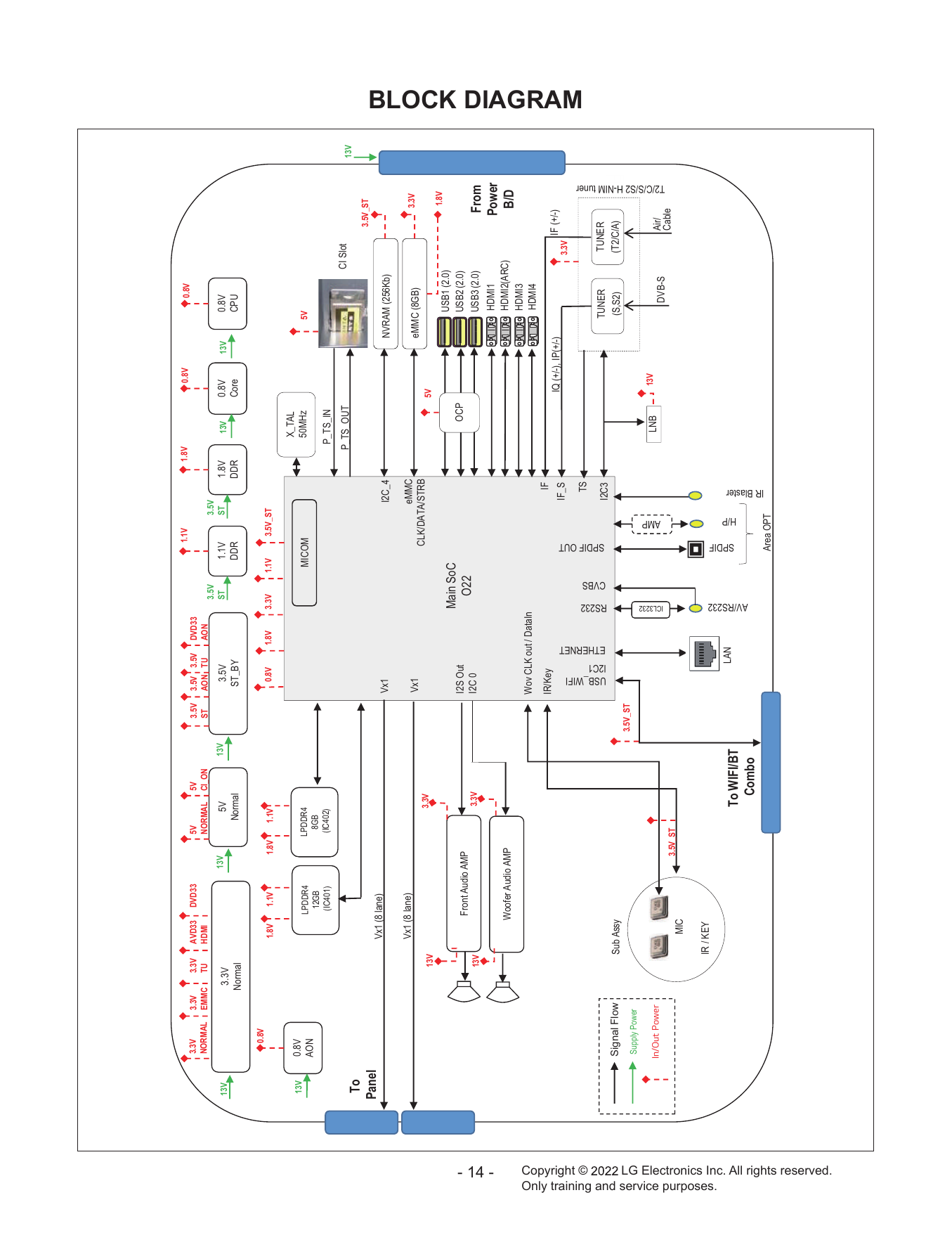
1.1V 1.8V 0.8V 0.8V
3.3V 3.3V 3.3V AVD33 DVD33 5V 5V 3.5V 3.5V 3.5V DVD33
NORMAL EMMC TU HDMI NORMAL CI_ON ST AON TU AON
3.5V 3.5V
13V 13V 5V 13V 3.5V ST 1.1V ST 1.8V 13V 0.8V 13V 0.8V
3.3V
Normal Normal ST_BY DDR DDR Core CPU
0.8V
1.8V 1.1V 1.8V 1.1V 0.8V 1.8V 3.3V 1.1V 3.5V_ST
X_TAL
13V 0.8V
LPDDR4 LPDDR4 MICOM 50MHz 5V
AON 8GB
12GB
(IC401) (IC402) P_TS_IN
P_TS_OUT CI Slot 13V
To
3.5V_ST
Panel Vx1 (8 lane)
Vx1 I2C_4 NVRAM (256Kb)
Vx1 (8 lane) eMMC 3.3V
Vx1 eMMC (8GB)
3.3V CLK/DATA/STRB
13V 5V
1.8V
USB1 (2.0)
Main SoC
Front Audio AMP I2S Out OCP USB2 (2.0)
3.3V I2C 0
O22
13V USB3 (2.0) From
- 14 -
HDMI1 Power
Woofer Audio AMP HDMI2(ARC)
B/D
HDMI3
Wov CLK out / DataIn HDMI4
IR/Key IF
IQ (+/-), IP(+/-) IF (+/-)
IF_S 3.3V
BLOCK DIAGRAM
Copyright ©
TS
tuner
SPDIF OUT
ETHERNET
CVBS
USB_WIFI
I2C1
RS232 I2C3 TUNER TUNER
Signal Flow Sub Assy (S,S2) (T2/C/A)
H-
3.5V_ST
Supply Power
LNB 13V
AMP
,Q2XW3RZHU
ICL3232
Air/
T2/C/S/S2 H-NIM
DVB-S
3.5V_ST Cable
MIC
IR / KEY
Only training and service purposes.
LAN
SPDIF
H/P
To WIFI/BT
AV/RS232
Combo
IR Blaster
Area OPT
LG Electronics Inc. All rights reserved.
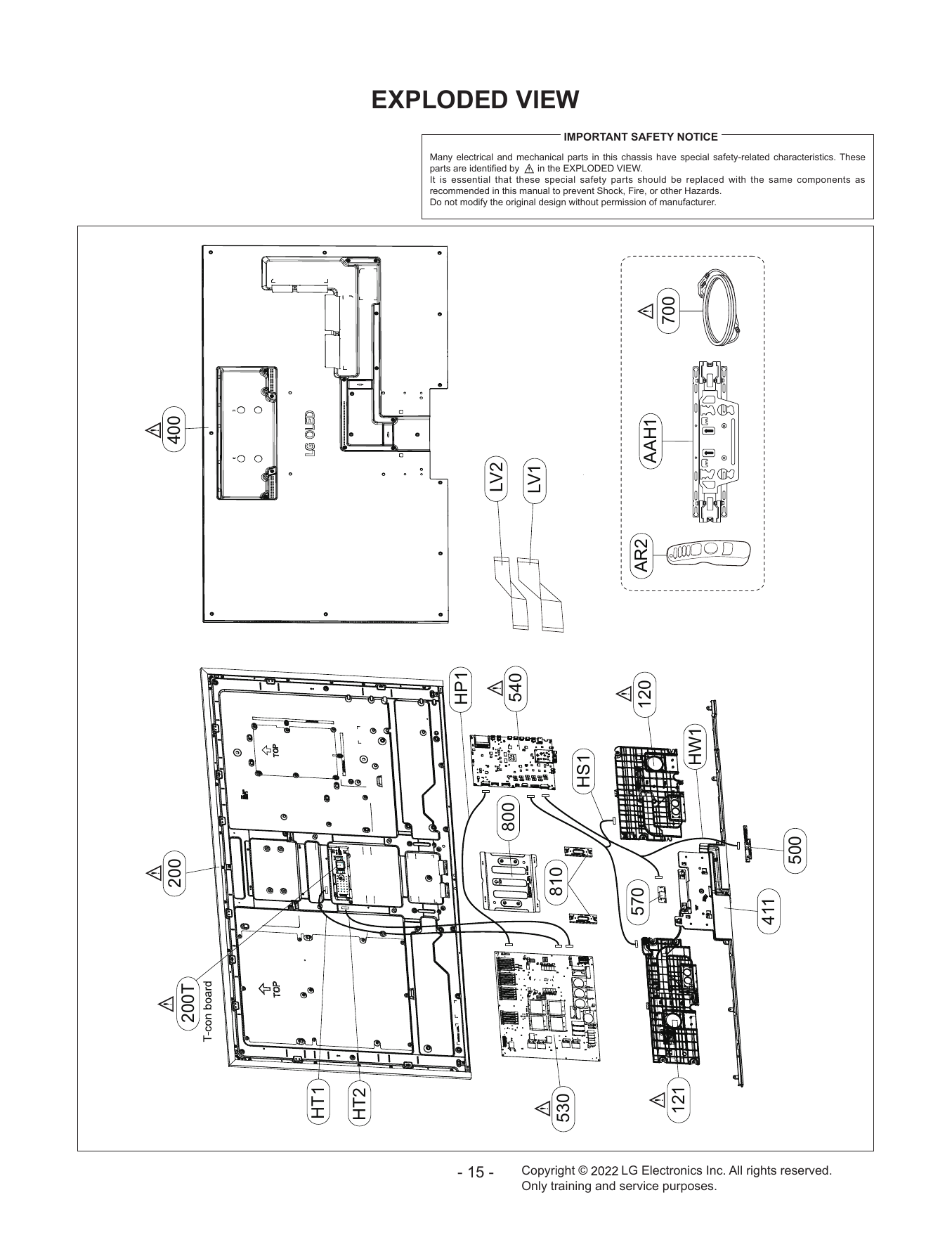
EXPLODED VIEW
IMPORTANT SAFETY NOTICE
Many electrical and mechanical parts in this chassis have special safety-related characteristics. These
parts are identified by in the EXPLODED VIEW.
It is essential that these special safety parts should be replaced with the same components as
recommended in this manual to prevent Shock, Fire, or other Hazards.
Do not modify the original design without permission of manufacturer.
700
400
AAH1
LV2
LV1
AR2
HP1
540
120
HW1
HS1
800
500
200
810
570
411
200T
121
HT1
HT2
530
- 15 - Copyright © LG Electronics Inc. All rights reserved.
Only training and service purposes.
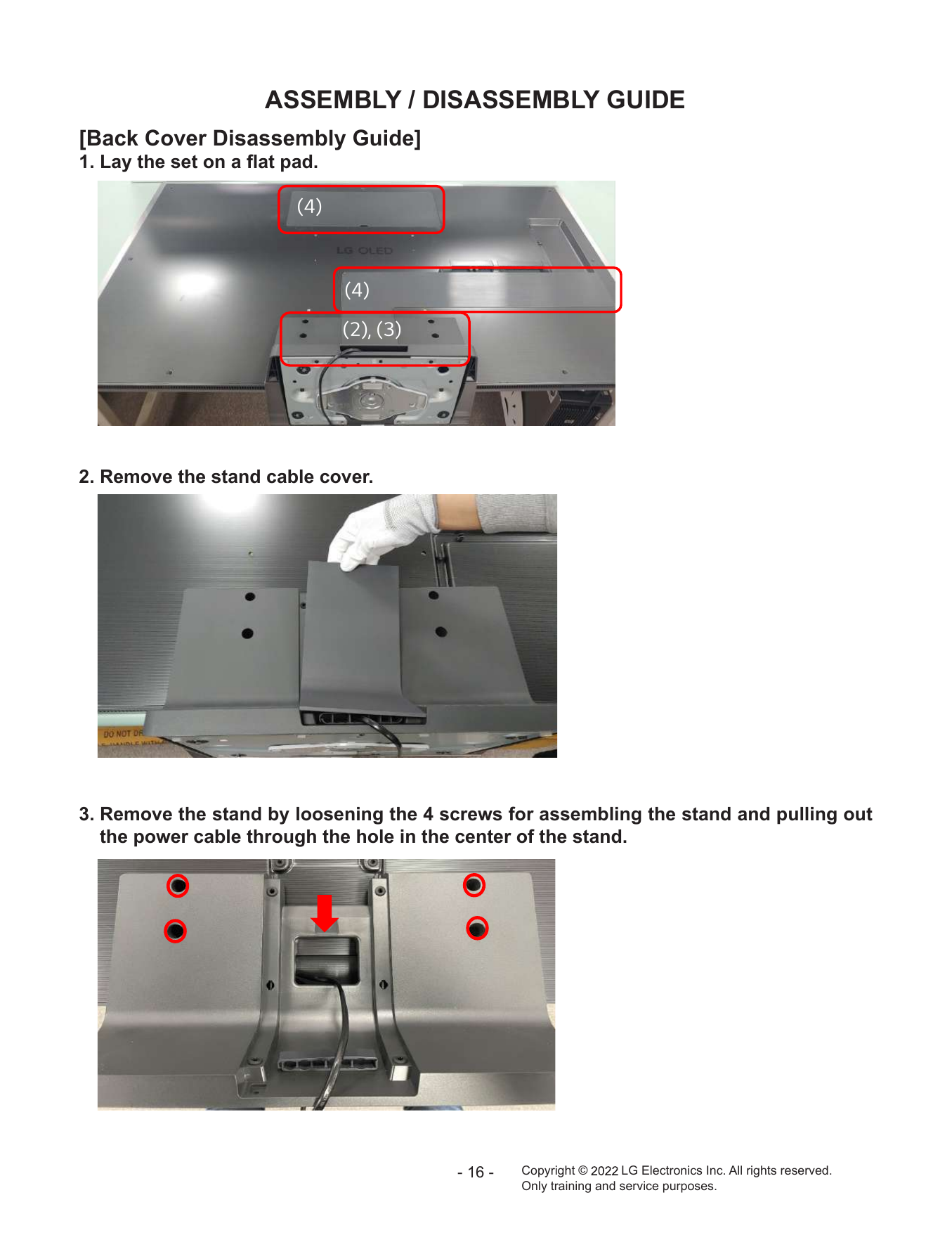
ASSEMBLY / DISASSEMBLY GUIDE
[Back Cover Disassembly Guide]
1. Lay the set on a flat pad.
(4)
(4)
(2), (3)
2. Remove the stand cable cover.
3. Remove the stand by loosening the 4 screws for assembling the stand and pulling out
the power cable through the hole in the center of the stand.
- 16 - Copyright © LG Electronics Inc. All rights reserved.
Only training and service purposes.
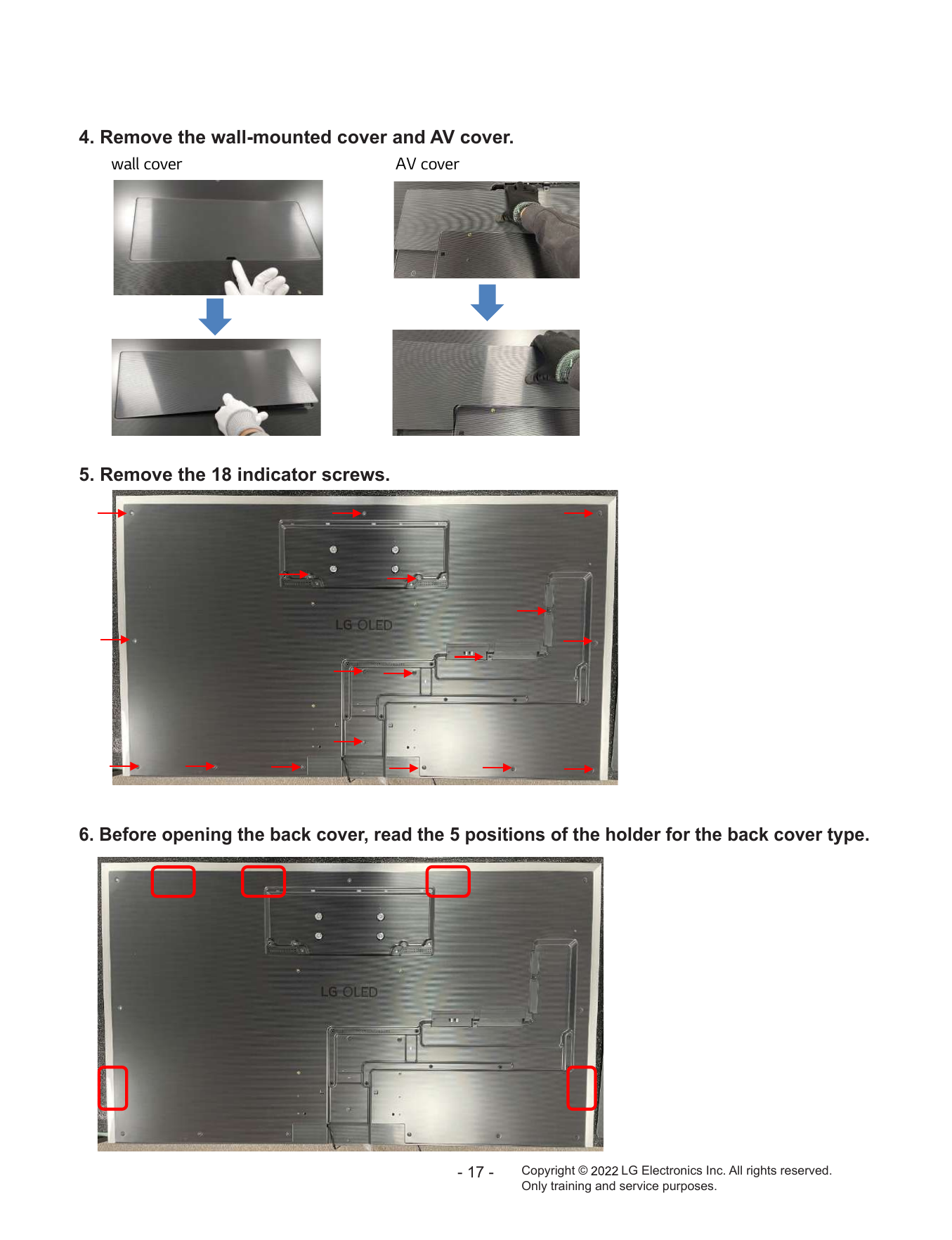
4. Remove the wall-mounted cover and AV cover.
wall cover AV cover
5. Remove the 18 indicator screws.
6. Before opening the back cover, read the 5 positions of the holder for the back cover type.
- 17 - Copyright © LG Electronics Inc. All rights reserved.
Only training and service purposes.
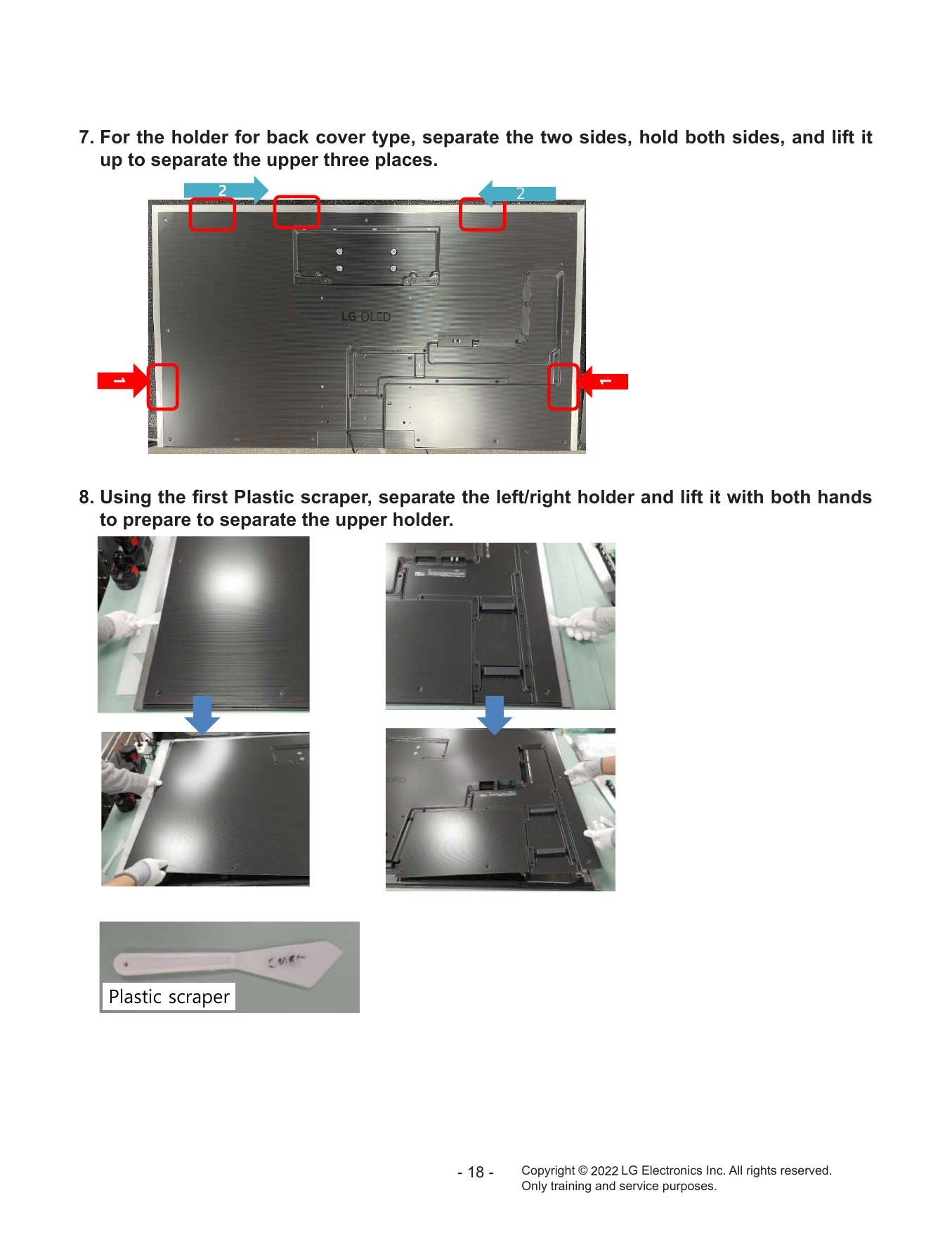
7. For the holder for back cover type, separate the two sides, hold both sides, and lift it
up to separate the upper three places.
2 2
1
1
8. Using the first Plastic scraper, separate the left/right holder and lift it with both hands
to prepare to separate the upper holder.
Plastic scraper
- 18 - Copyright © LG Electronics Inc. All rights reserved.
Only training and service purposes.
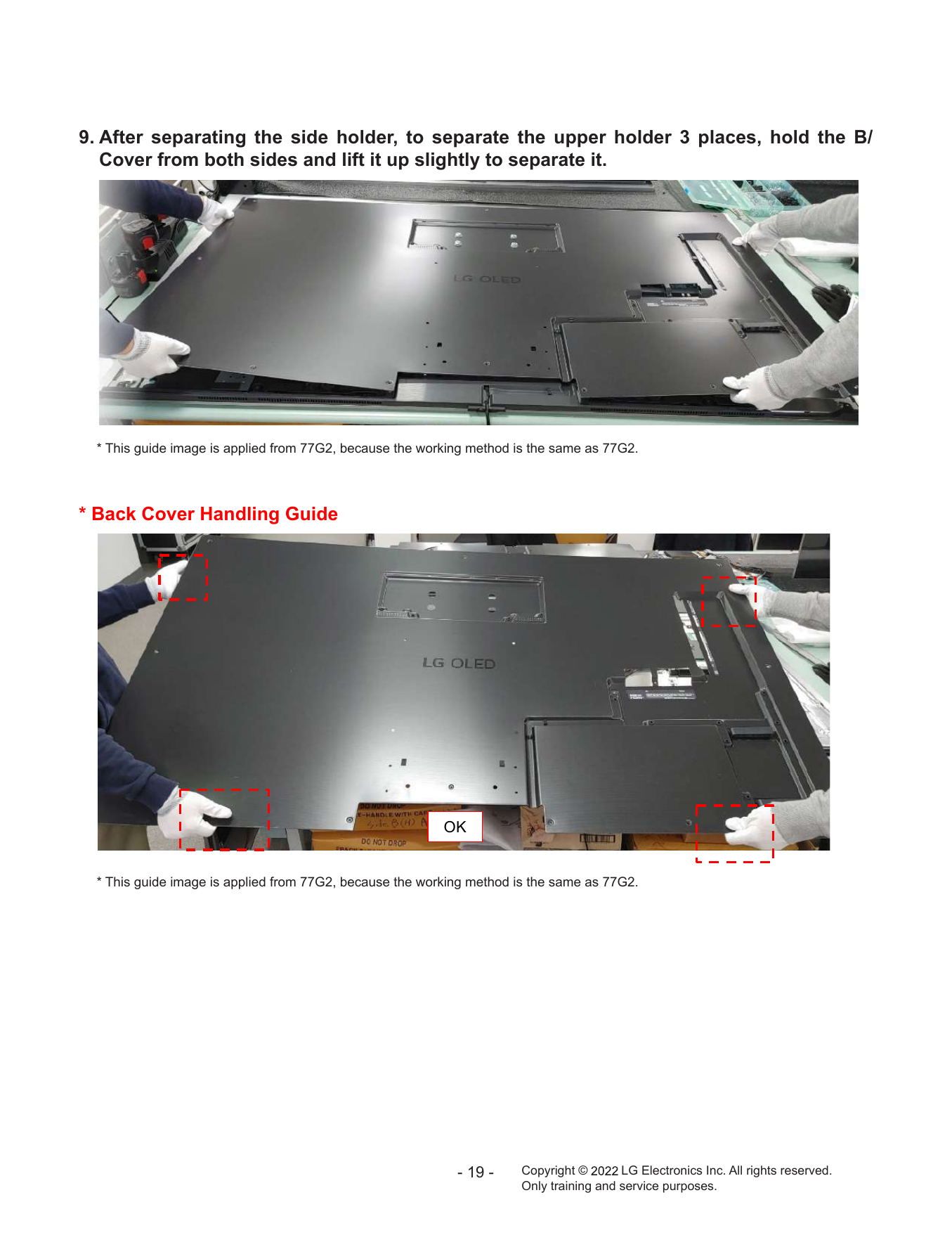
9. After separating the side holder, to separate the upper holder 3 places, hold the B/
Cover from both sides and lift it up slightly to separate it.
* This guide image is applied from 77G2, because the working method is the same as 77G2.
* Back Cover Handling Guide
OK
* This guide image is applied from 77G2, because the working method is the same as 77G2.
- 19 - Copyright © LG Electronics Inc. All rights reserved.
Only training and service purposes.
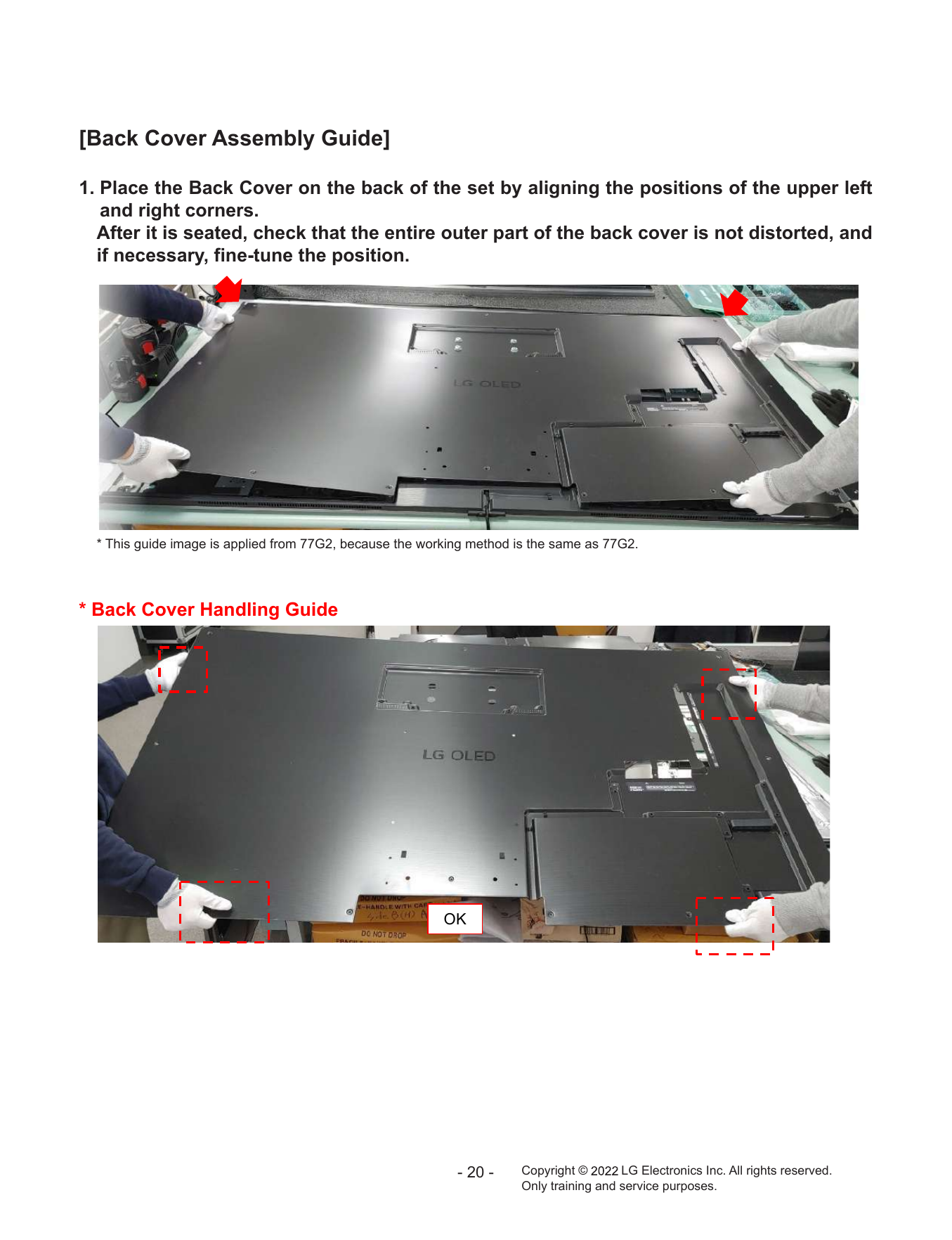
[Back Cover Assembly Guide]
1. Place the Back Cover on the back of the set by aligning the positions of the upper left
and right corners.
After it is seated, check that the entire outer part of the back cover is not distorted, and
if necessary, fine-tune the position.
* This guide image is applied from 77G2, because the working method is the same as 77G2.
* Back Cover Handling Guide
OK
- 20 - Copyright © LG Electronics Inc. All rights reserved.
Only training and service purposes.
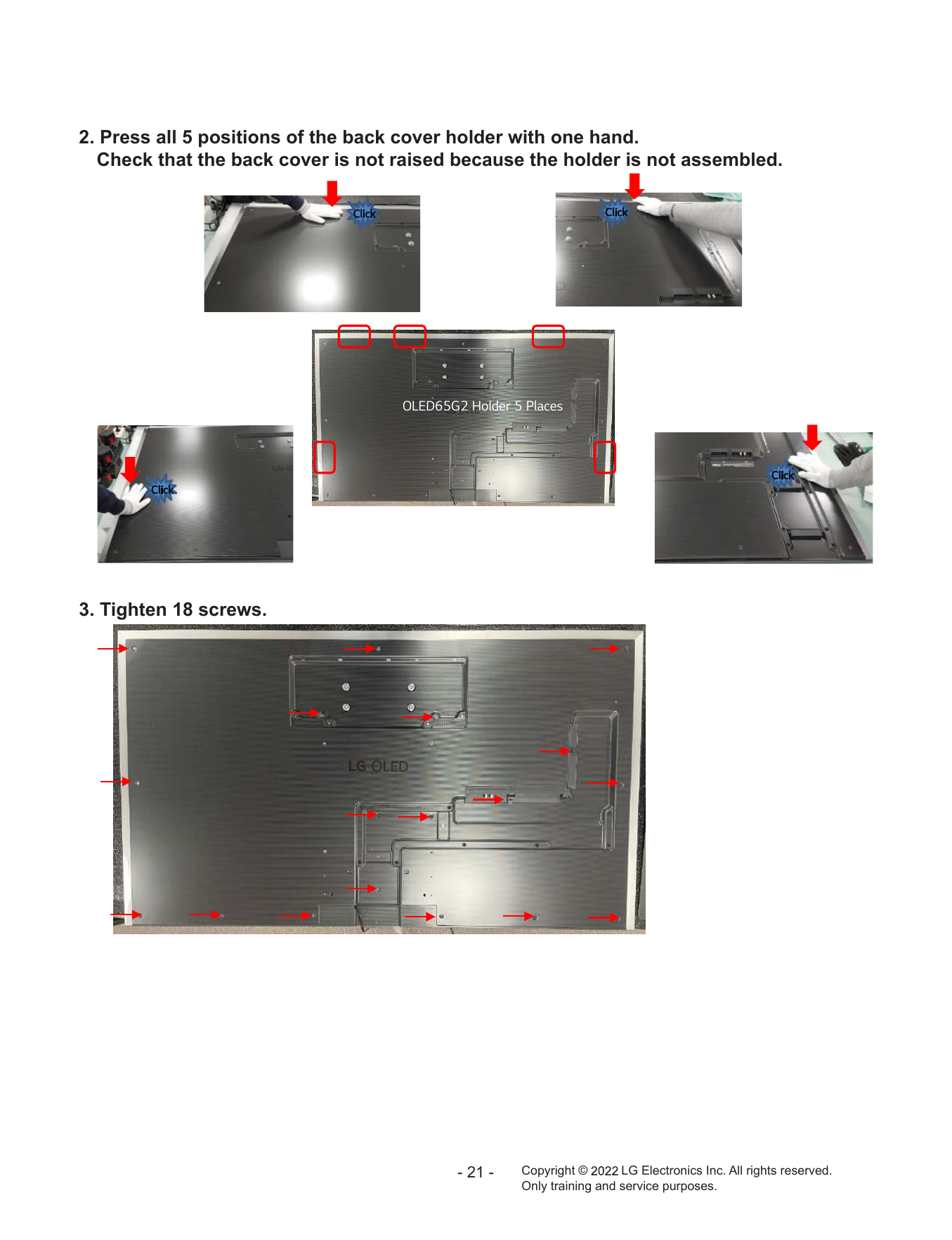
2. Press all 5 positions of the back cover holder with one hand.
Check that the back cover is not raised because the holder is not assembled.
Click Click
OLED65G2 Holder 5 Places
Click
Click
3. Tighten 18 screws.
- 21 - Copyright © LG Electronics Inc. All rights reserved.
Only training and service purposes.
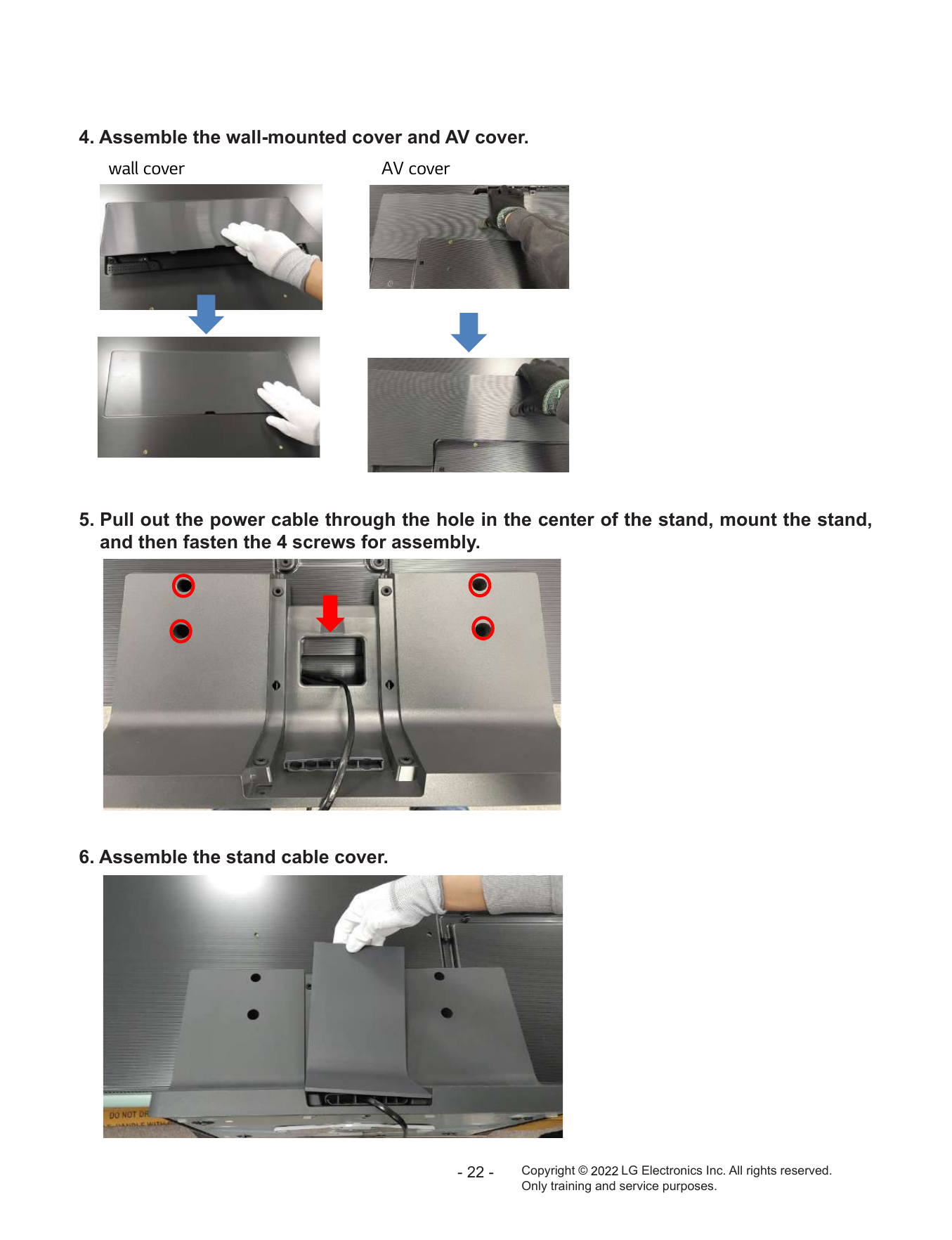
4. Assemble the wall-mounted cover and AV cover.
wall cover AV cover
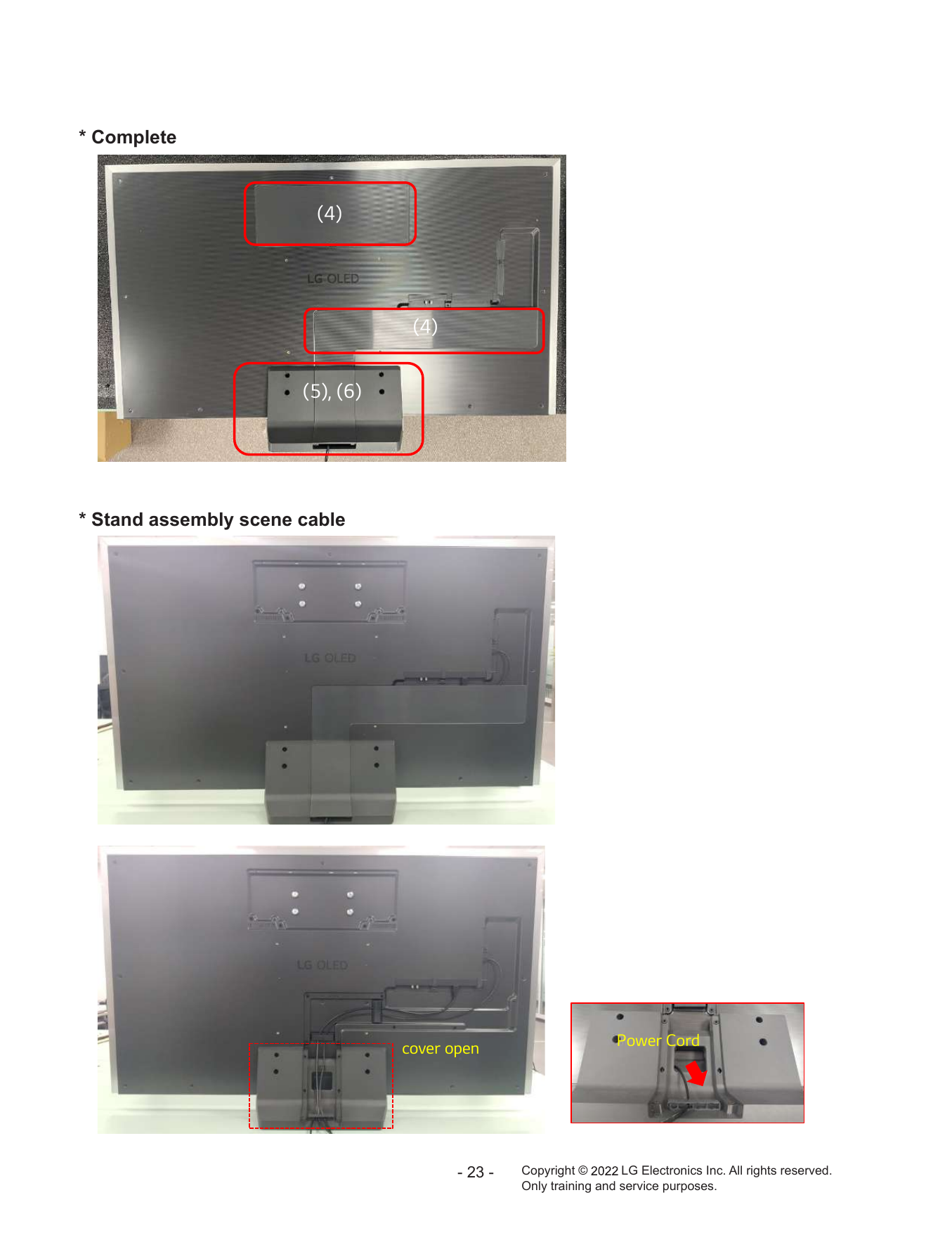
5. Pull out the power cable through the hole in the center of the stand, mount the stand,
and then fasten the 4 screws for assembly.
6. Assemble the stand cable cover.
- 22 - Copyright © LG Electronics Inc. All rights reserved.
Only training and service purposes.
* Complete
(4)
(4)
(5), (6)
* Stand assembly scene cable
cover open Power Cord
- 23 - Copyright © LG Electronics Inc. All rights reserved.
Only training and service purposes.
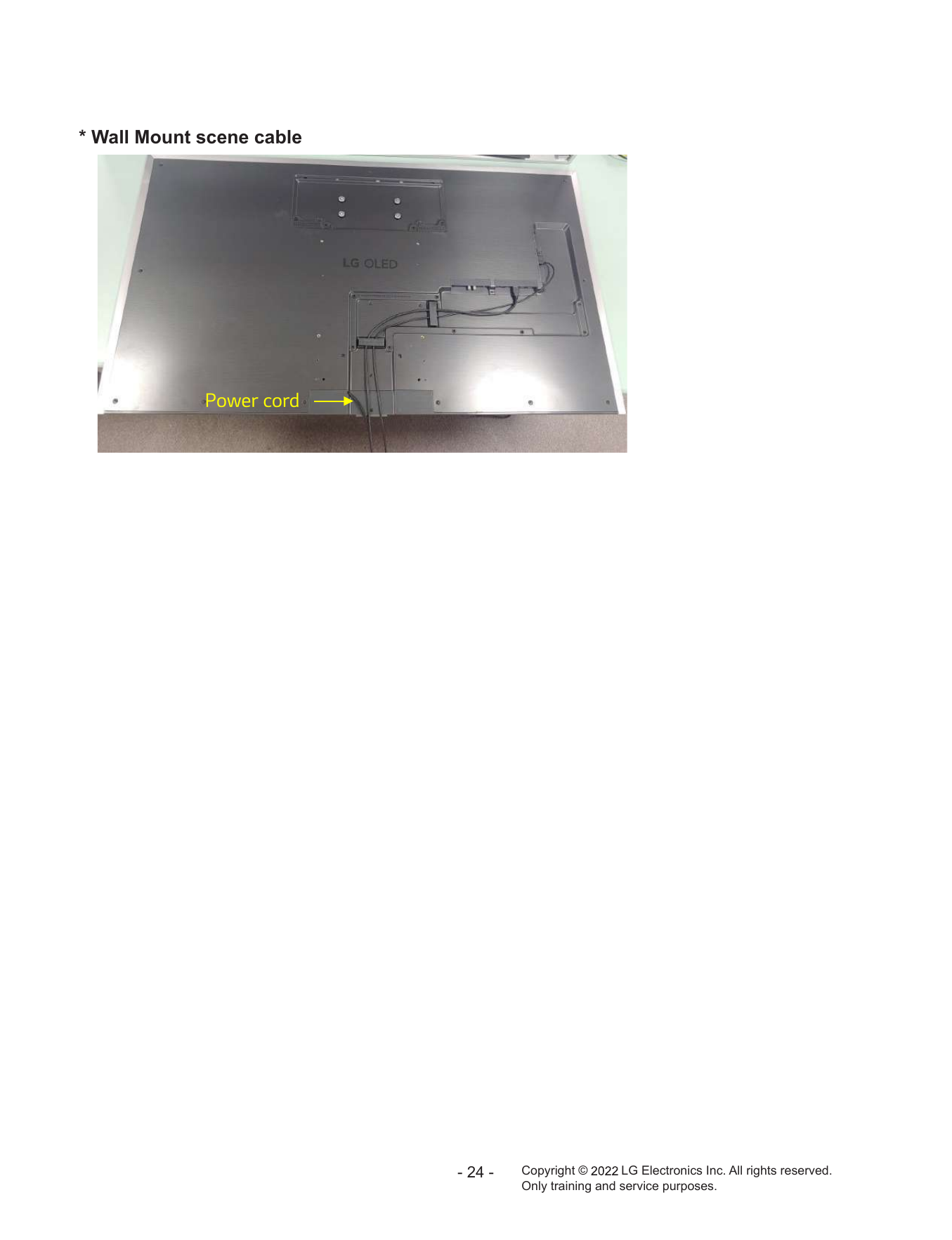
* Wall Mount scene cable
Power cord
- 24 - Copyright © LG Electronics Inc. All rights reserved.
Only training and service purposes.